

This is a question I had: how fast is a second hand on a clock?
And if you start looking, you’ll find plenty of websites aimed at elementary school kids that ultimately tell you that a second hand covers a whole rotation every minute so … (trivial math) … resulting in a rotation rate of 6 degrees per second or ≈0.105 radians per seconds. The problem I have with this is that this is not my question, nor does it answer it. I am wondering how fast is a second hand when it is moving.
Unless the clock you have has a second hand that constantly sweeps, most analog clocks have the second hand move, then rest for most of the second – making the characteristic ticking sound. To find out, there’s two ways to do so: do a bunch of research on quartz crystals, their construction and design, then start to read into some esoteric time keeping articles, or… play with a high speed camera.
I had the opportunity to borrow a high speed camera (a pco.camera), so I did that. And I tried it on two different clocks: the baby dinosaur and weather.

The baby dinosaur clock I’ve had since 1993 or 1994; it was either a birthday present or a Christmas gift. From personal experience it makes a barely perceptual ‘tic-tic-tic’ sound during the day and a booming ‘CLOCK! CLOCK! CLOCK!’ sound in the middle of the night. I’ve recently found it buried in a box and pulled it out for this. The weather clock is so named as it also tells the relative humidity and temperature. I bought it about a year ago.
I set them down on the floor in the sunlight so there was enough light for the camera – at the framerate the camera ran at, the flickering fluorescence lights was a huge annoyance. And here they are:

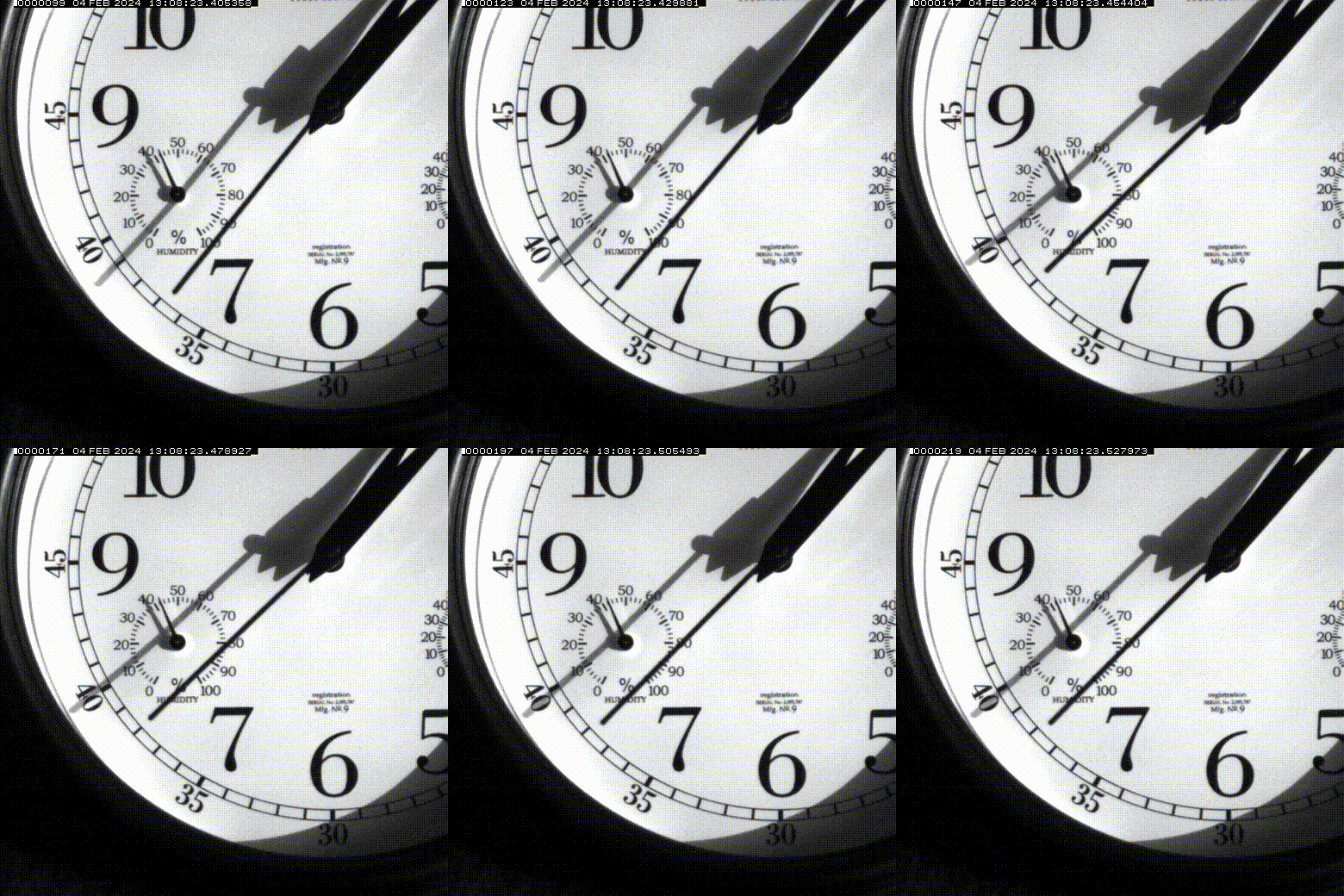
Each frame is ~1 millisecond. I’ve cut it down to just when the second hand is moving.
Because the weather had second marks (one marker every 6 degrees), it was easier to determine the speed. From when it started moving to when it stopped moving, it took about 73-75 milliseconds, meaning the second hand was moving at an average of 80 degrees per second (≈1.4 radians / second) for the entire time it was moving.
But it actually travels farther than that while it moves! It overshoots its mark and then bounces back. So from the time it first started moving to when it first covers 6 degrees, I find that to be much faster, taking only about 28.5 milliseconds to cover, meaning a speed of 210 degrees / second (≈3.7 rad/sec). There’s also the time from when it first started moving to when it first stopped moving, which is when it slowed down and bounced back. I gave it an estimate that it overshot by 3 degrees, so it covered a total of 9 degrees from start to its turnaround point in only 45 milliseconds, which is 200 degrees /sec (≈3.5 rad/sec). I’m not gonna bother to estimate the acceleration. The baby dinosaur clock moves even faster, as it jumps slightly more than 12 degrees each second.
So taking its top speed, should the second hand move at that speed all the time, a whole minute would take just 1.7 seconds, an hour would be a minute and 43 seconds and a whole day would be over in just 41 minutes! So the second hand is really movin’ when it’s movin’.
 Orthallelous
Leave a comment